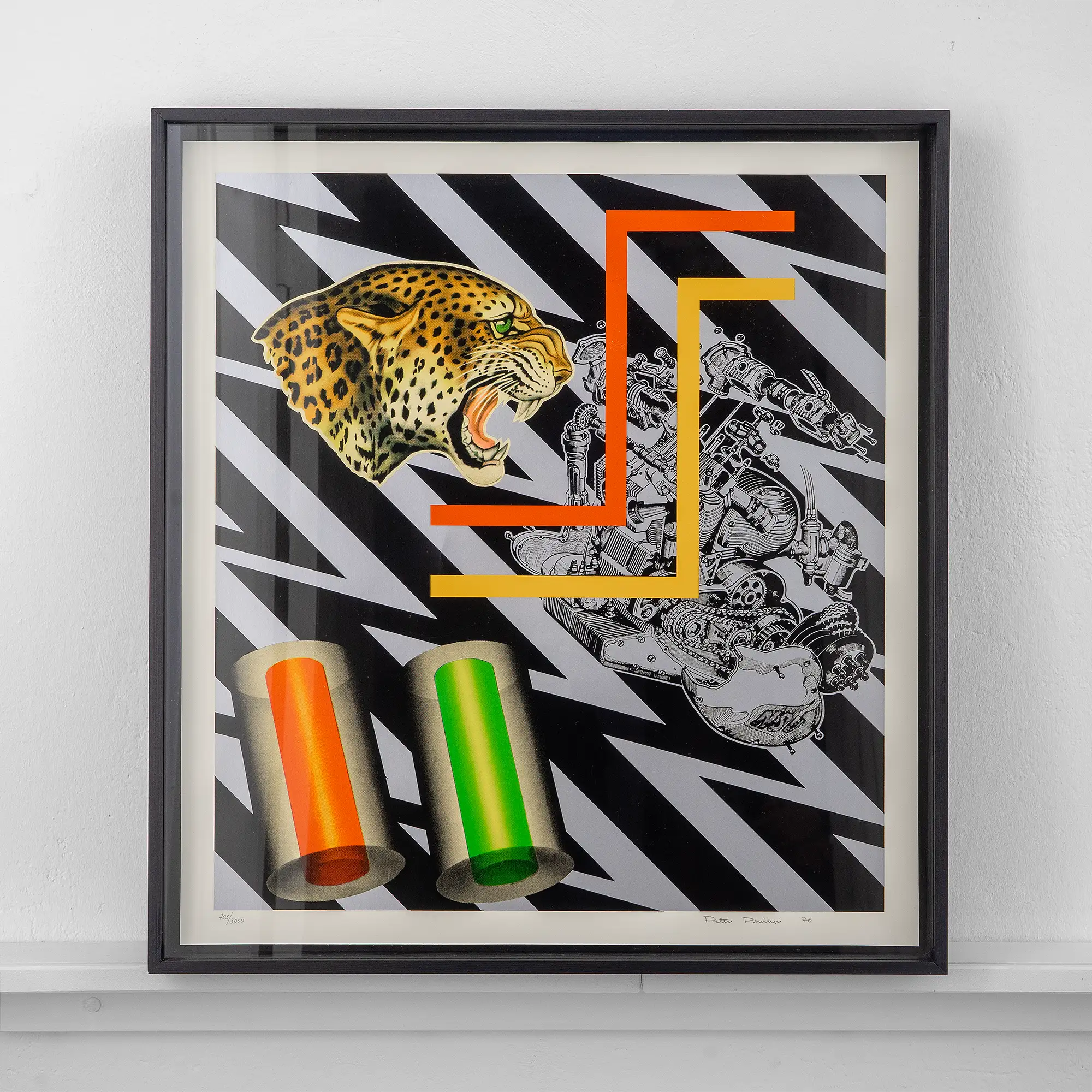
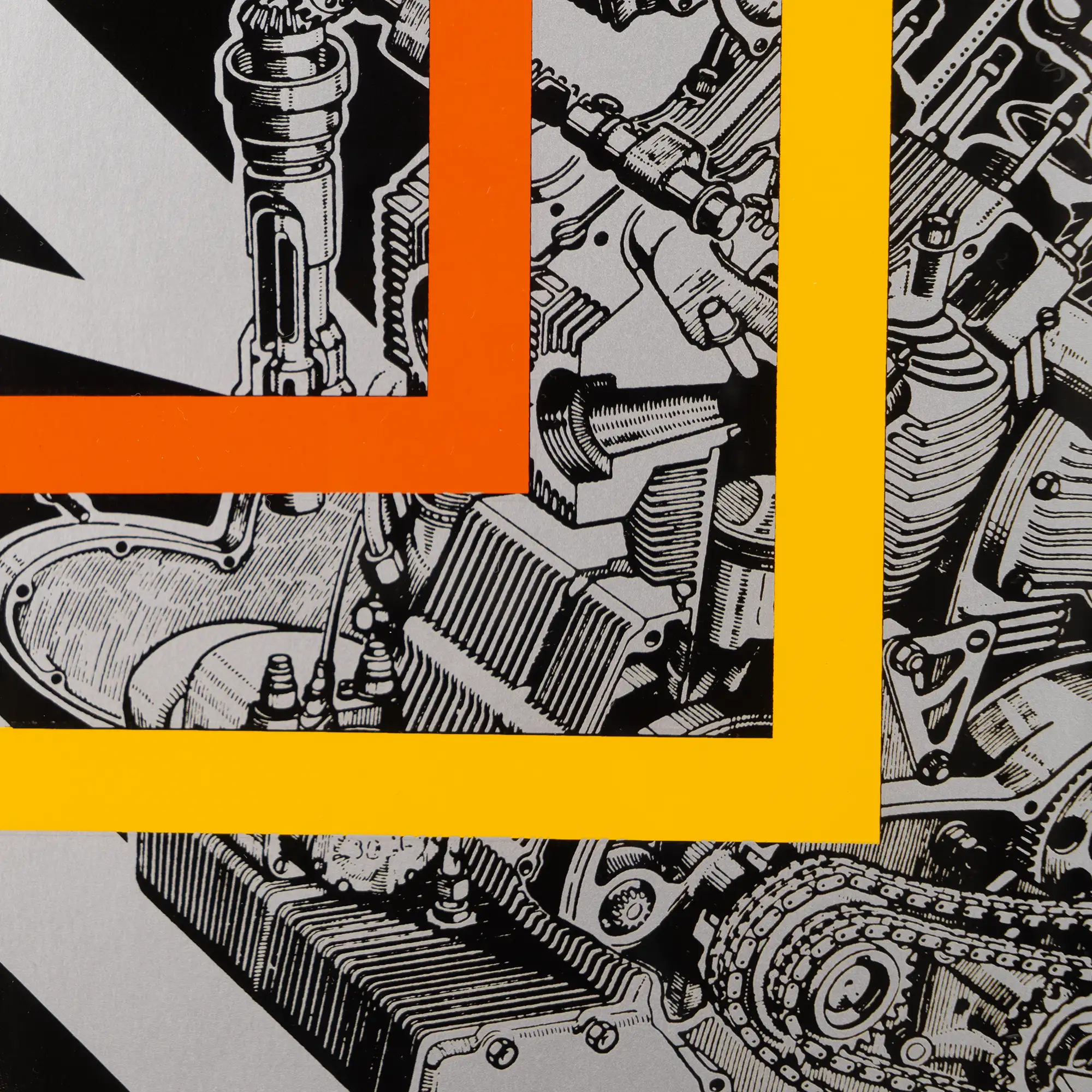
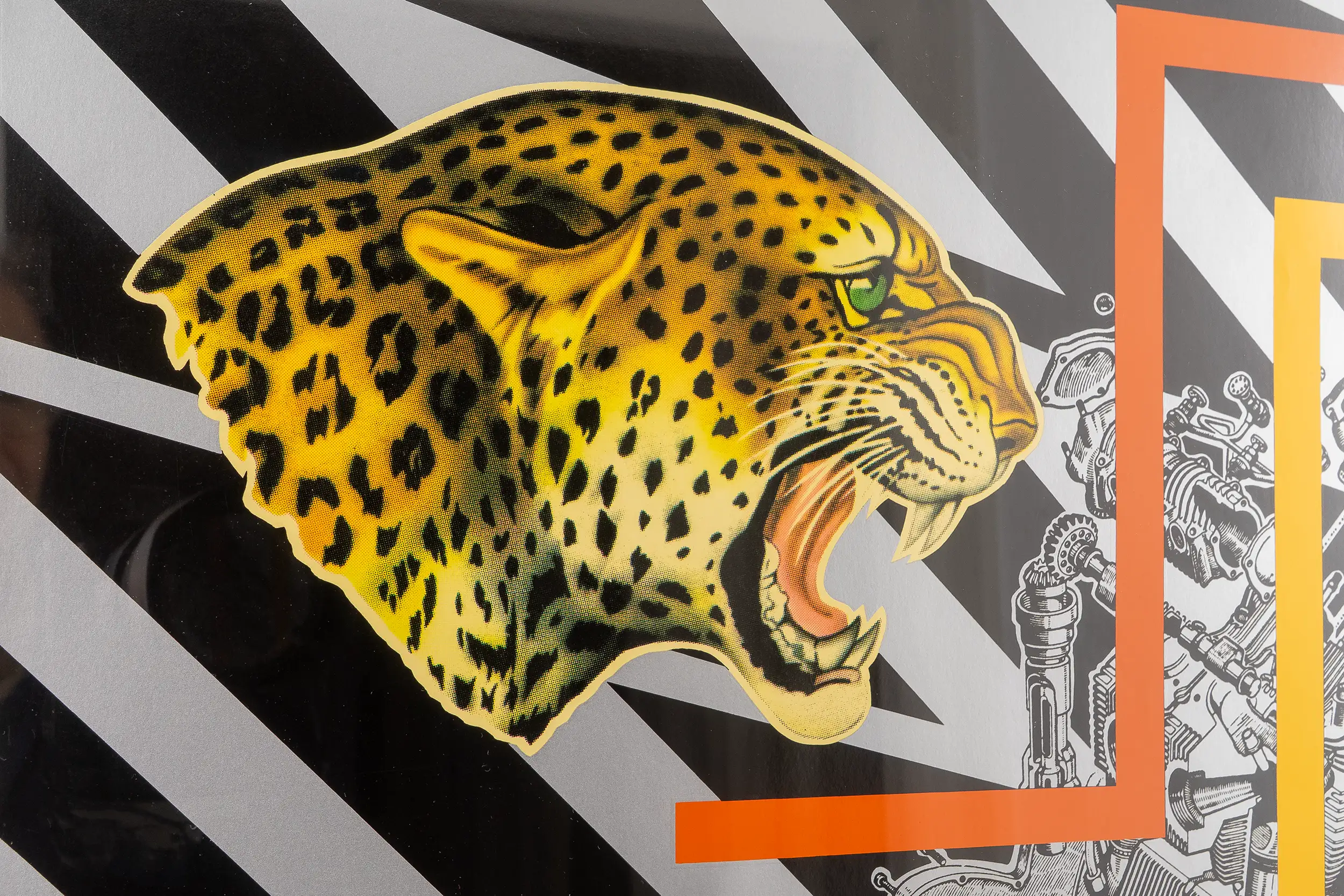
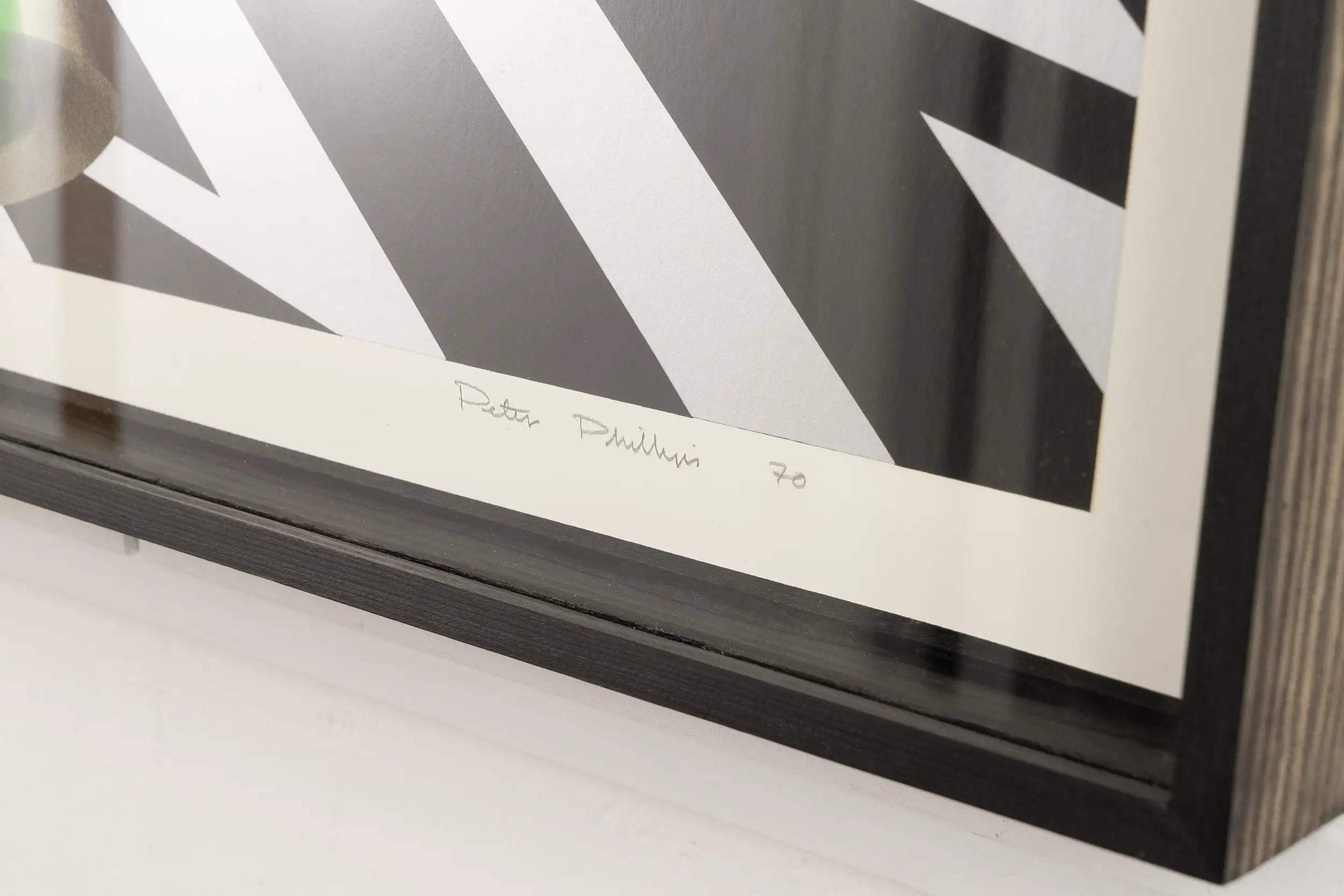
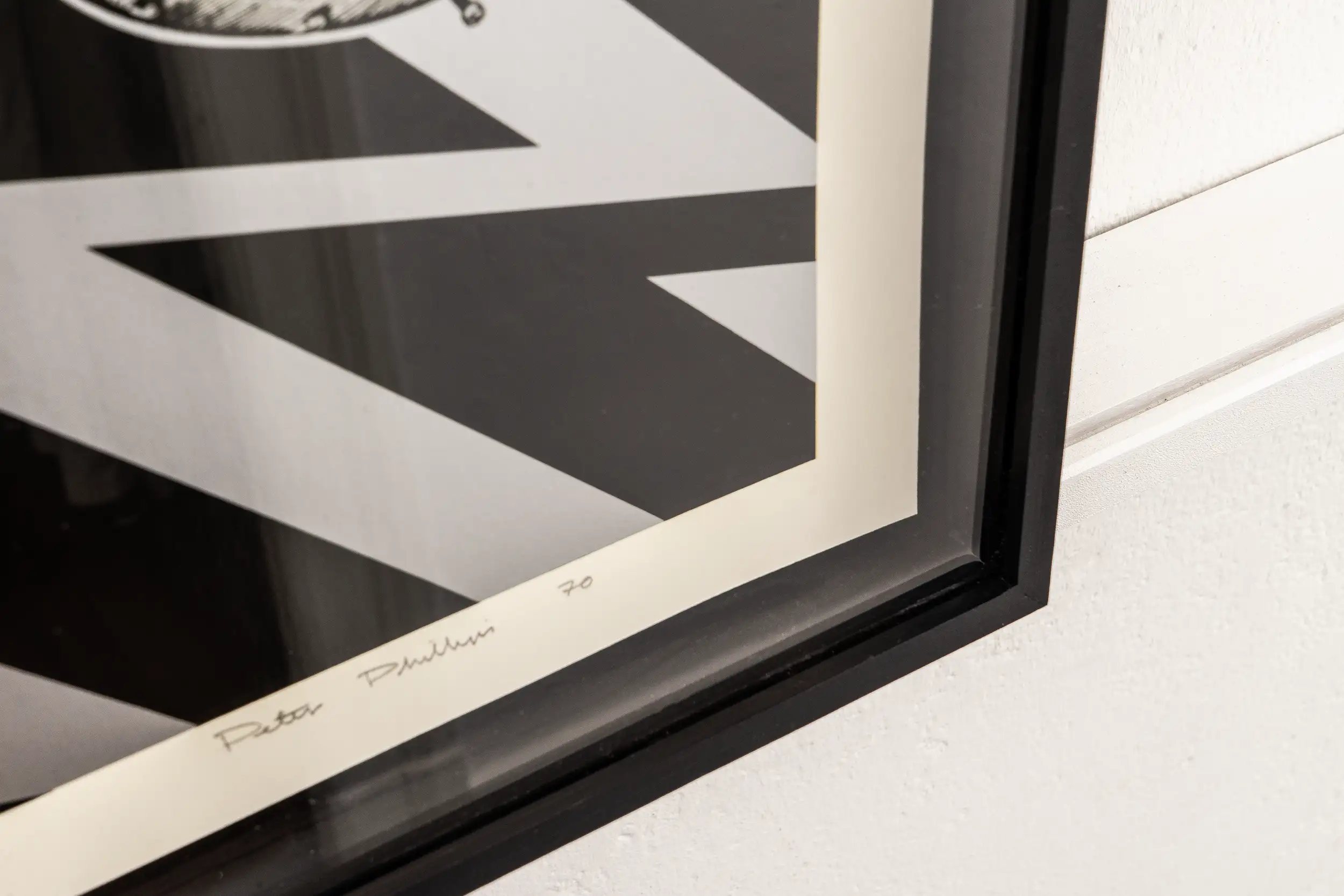
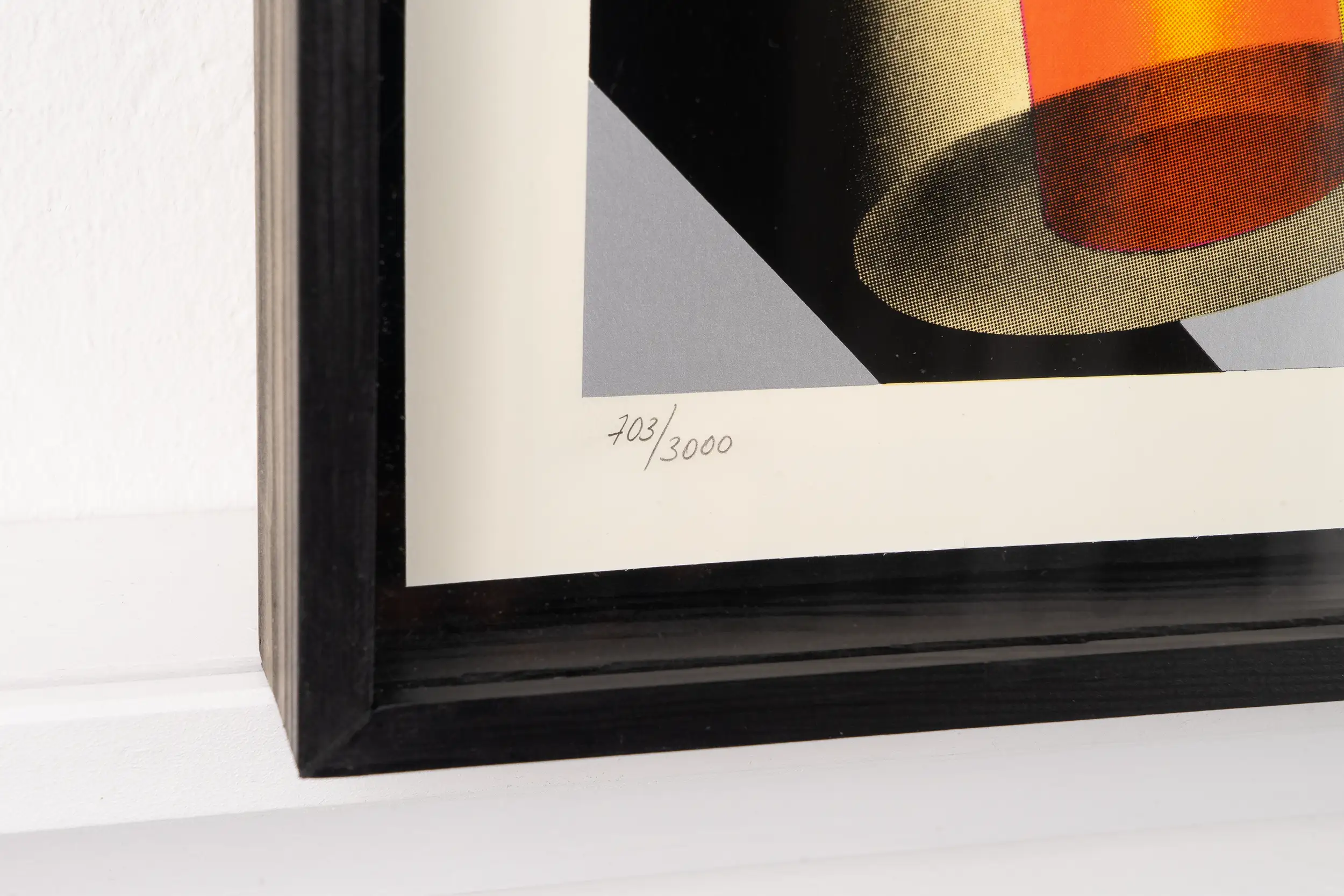
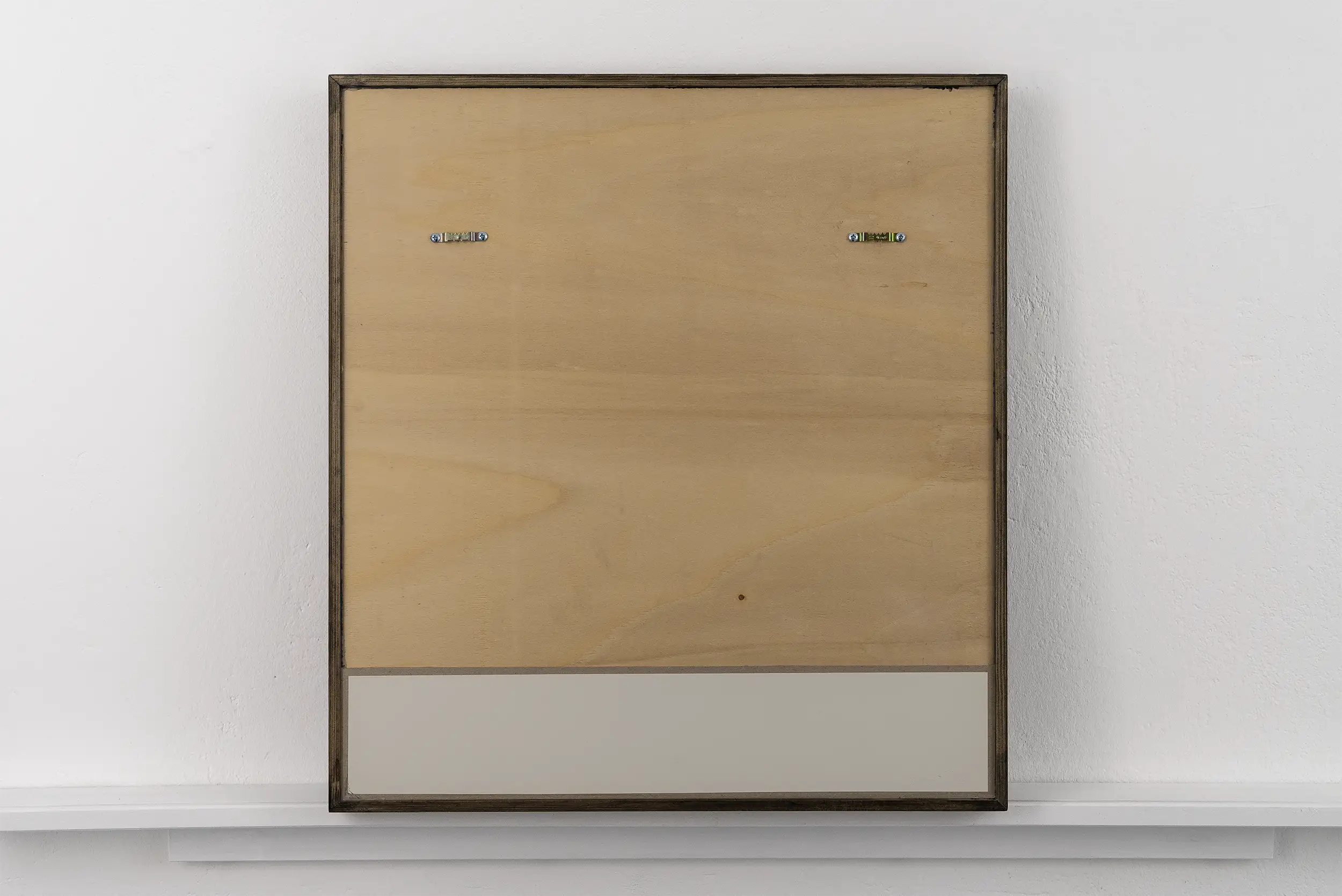
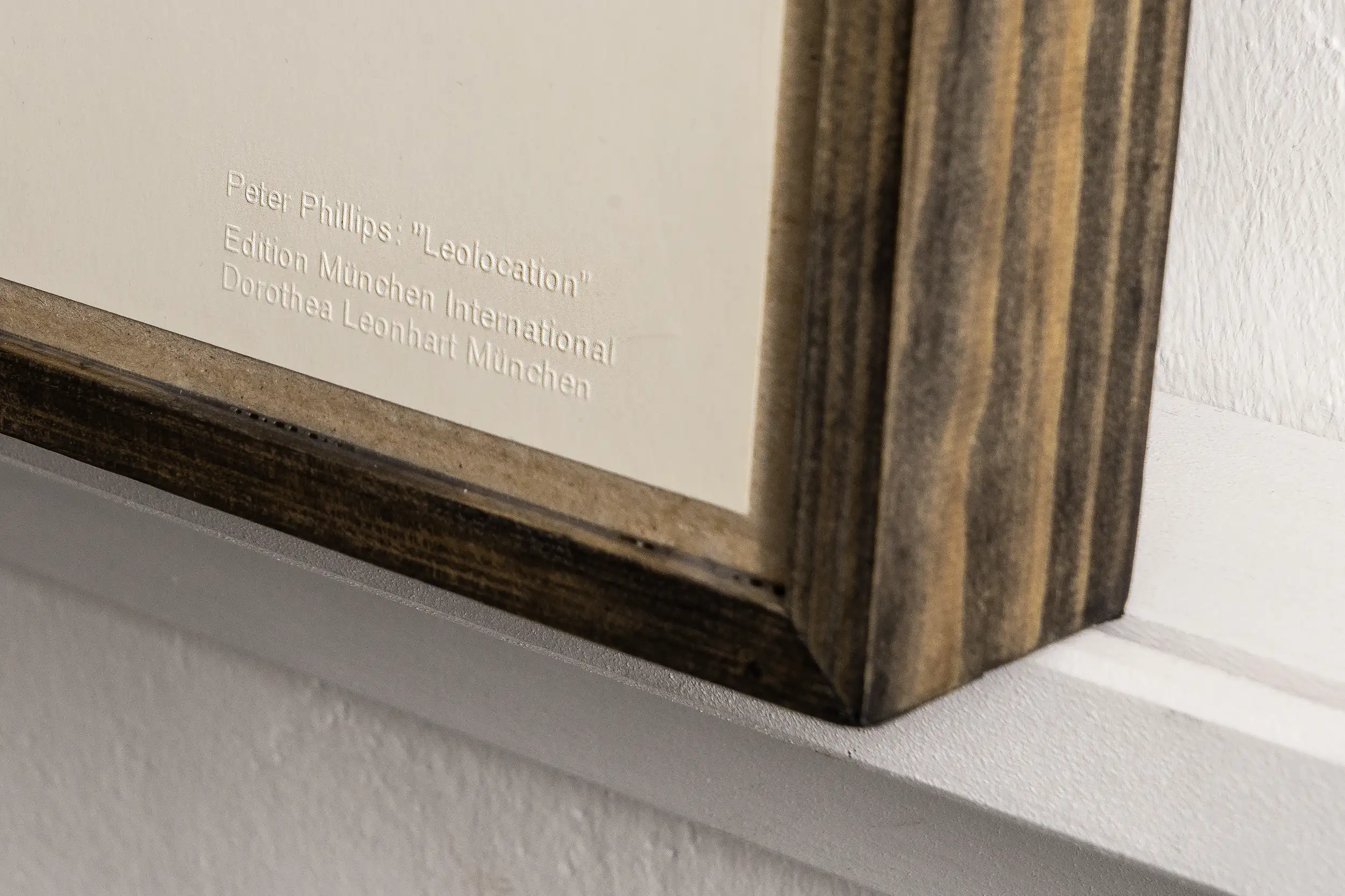
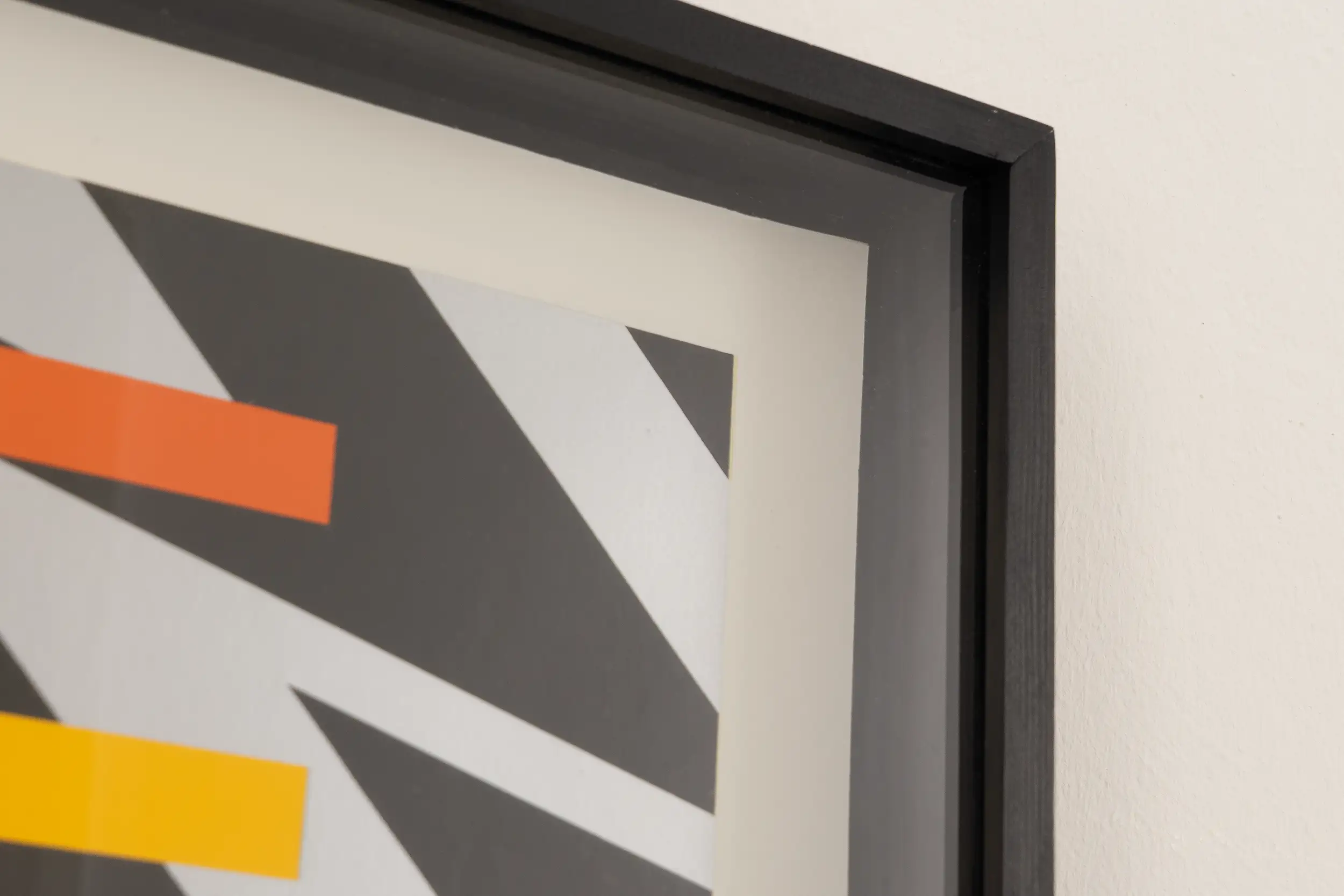
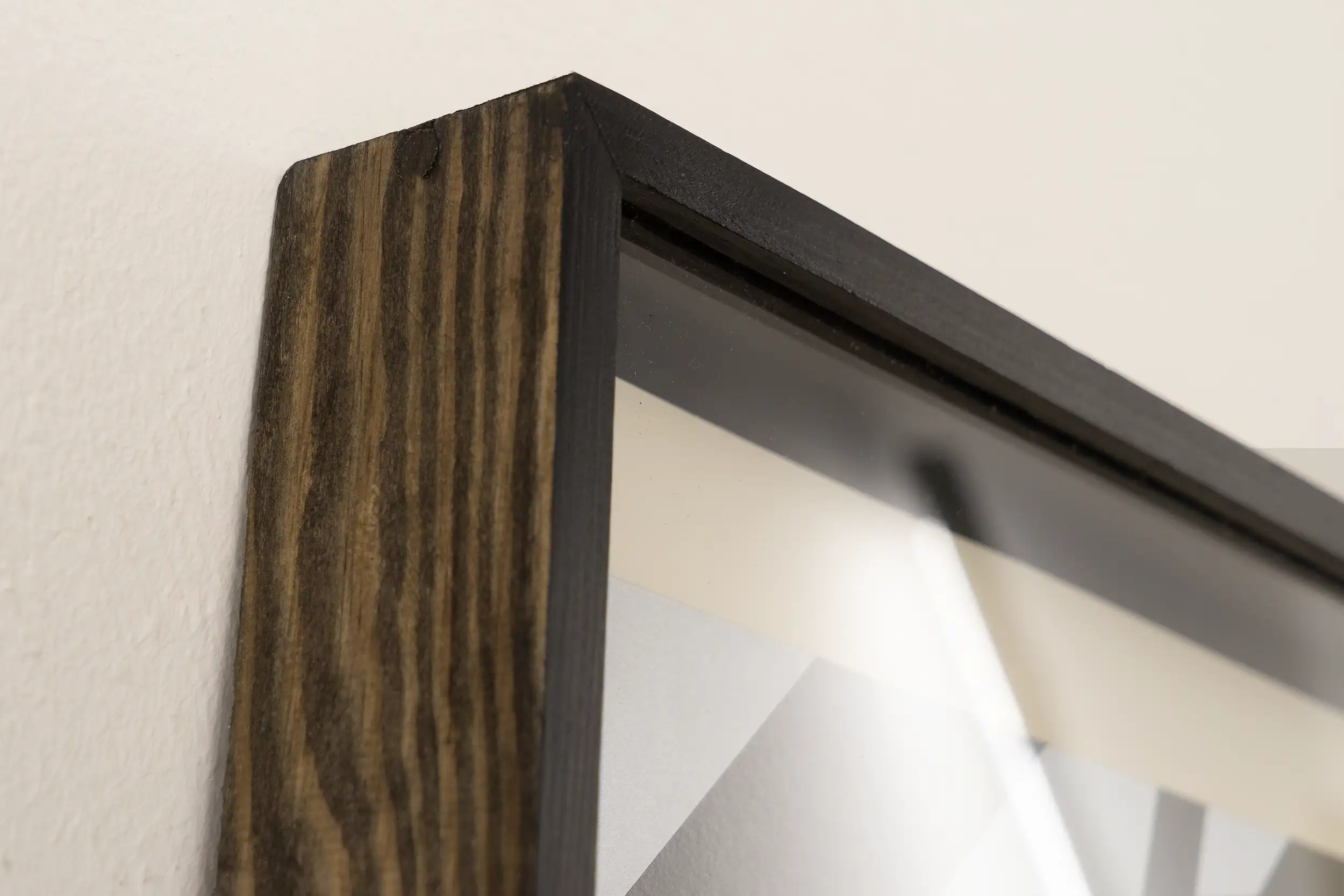
Leolocation is an original colour screen-print on smooth archival paper by British Pop Art artist Peter Phillips (1939–2025). Signed “Peter Phillips” in pencil, numbered 703/3000 and dated “70”. Limited edition print for Muenchen International, produced by Dorothea Leonhart, München. The image size is approximately 21.5 x 19.5 inches (54.3 x 49.3 cm) in a handmade gallery frame measuring about 21.7 x 23.6 inches (55 x 60 cm). The print has been professionally framed, with it being mounted in a gallery frame behind plexiglas. The oversized printing paper has been trimmed to fit the frame. The lowermost edge of the paper, bearing the blind stamp of the publisher, has been affixed to the rear of the frame, thereby serving as a certification of authenticity.
Prints like Leolocation have gained significance following the recent passing of Peter Phillips on June 23, 2025, at the age of 86. As one of the founding figures of British Pop Art, Phillips’s vibrant, collage-like compositions and innovative use of commercial imagery have left a lasting mark on postwar art. His death marks the end of an era for the movement he helped shape, and his edition prints are recognized as important pieces of his legacy.
Peter Phillips’s artistic career spanned a period of more than six decades and was distinguished by innovation and international acclaim. Phillips was born in Birmingham, England, and attended the Royal College of Art in London, where he studied alongside contemporaries such as David Hockney and Allen Jones. It was in the early 1960s that he first came to prominence, as a pioneering figure in the field of British Pop Art. He drew inspiration from a variety of sources, including advertising, industrial design, and mass culture. His dynamic montage paintings and screenprints frequently featured bold colour combinations alongside imagery derived from popular media sources.
Phillips participated in numerous exhibitions, including the Paris Biennale in 1963, the “Nieuwe Realisten” exhibition in The Hague in 1964, and exhibitions in galleries across Europe, the United States, and Australia. He resided and worked in New York, Zurich, Majorca, and finally Australia, where he established a gallery. His works are held in major museum collections, including the Tate and the Museum of Modern Art. Over the years, Phillips continued to evolve his style, incorporating new techniques and media, and remained a key influence in contemporary art until his passing.