Alan Sonfist (born 1946 in the Bronx, New York City) is deeply committed to the confluence of art, ecology and urban space. His seminal work, Time Landscape (1965–present), is a living monument in Lower Manhattan, New York City, where Sonfist and a community of collaborators have recreated a pre-colonial forest using indigenous plant species. Time Landscape was conceived as a public memorial to the natural history of the city. It offers a rare glimpse into Manhattan’s ecological past and invites viewers to reflect on the ongoing relationship between urban development and the environment.
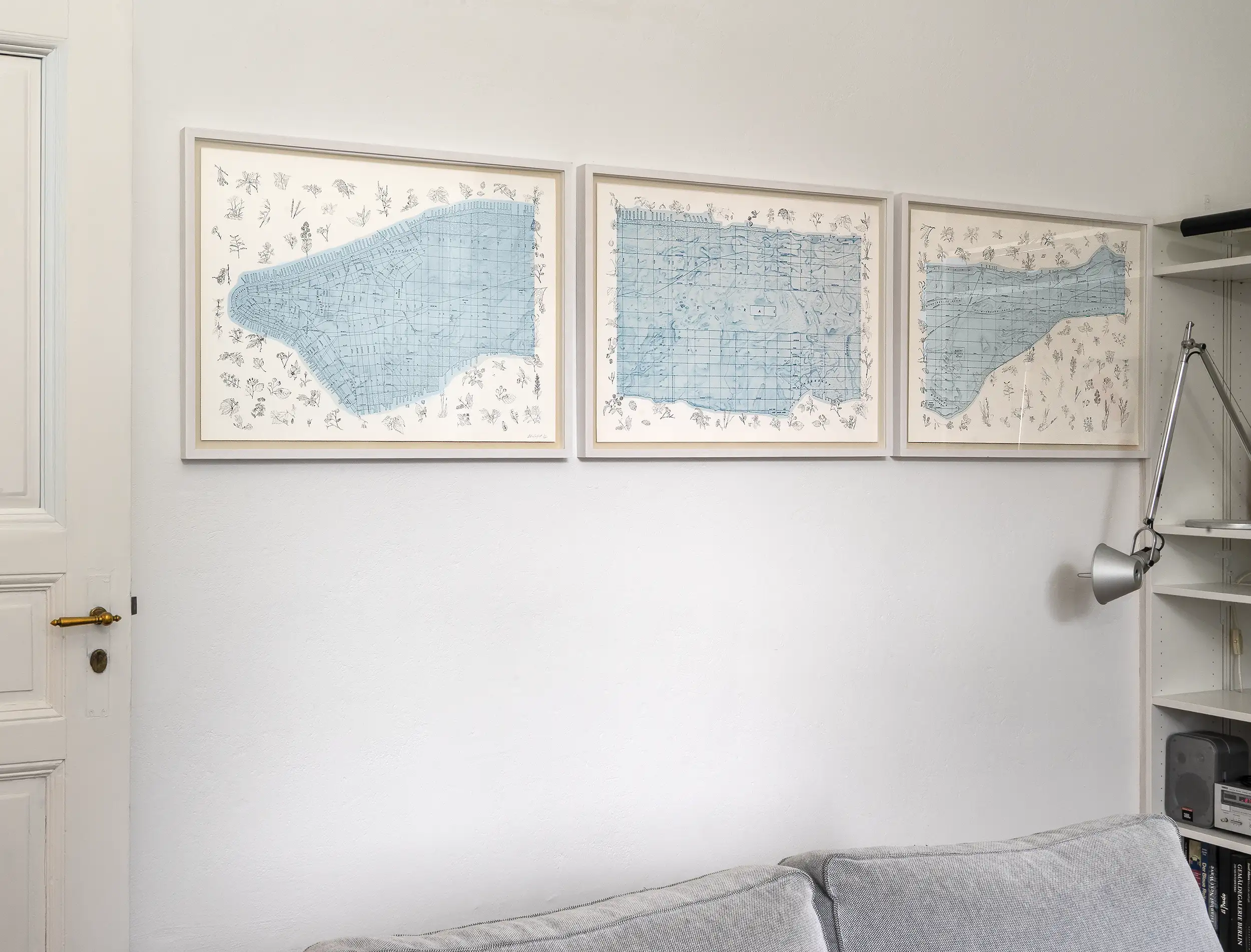
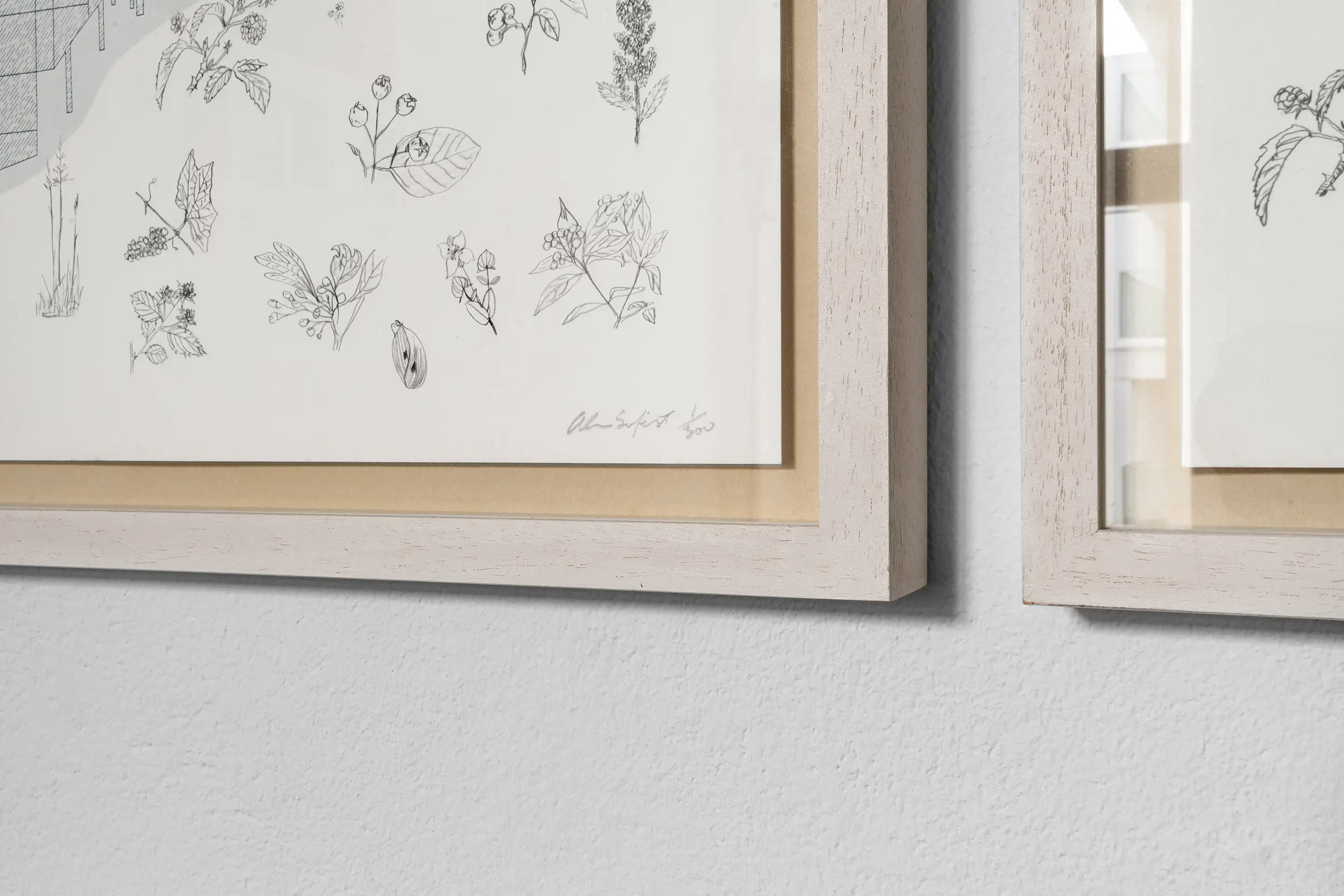
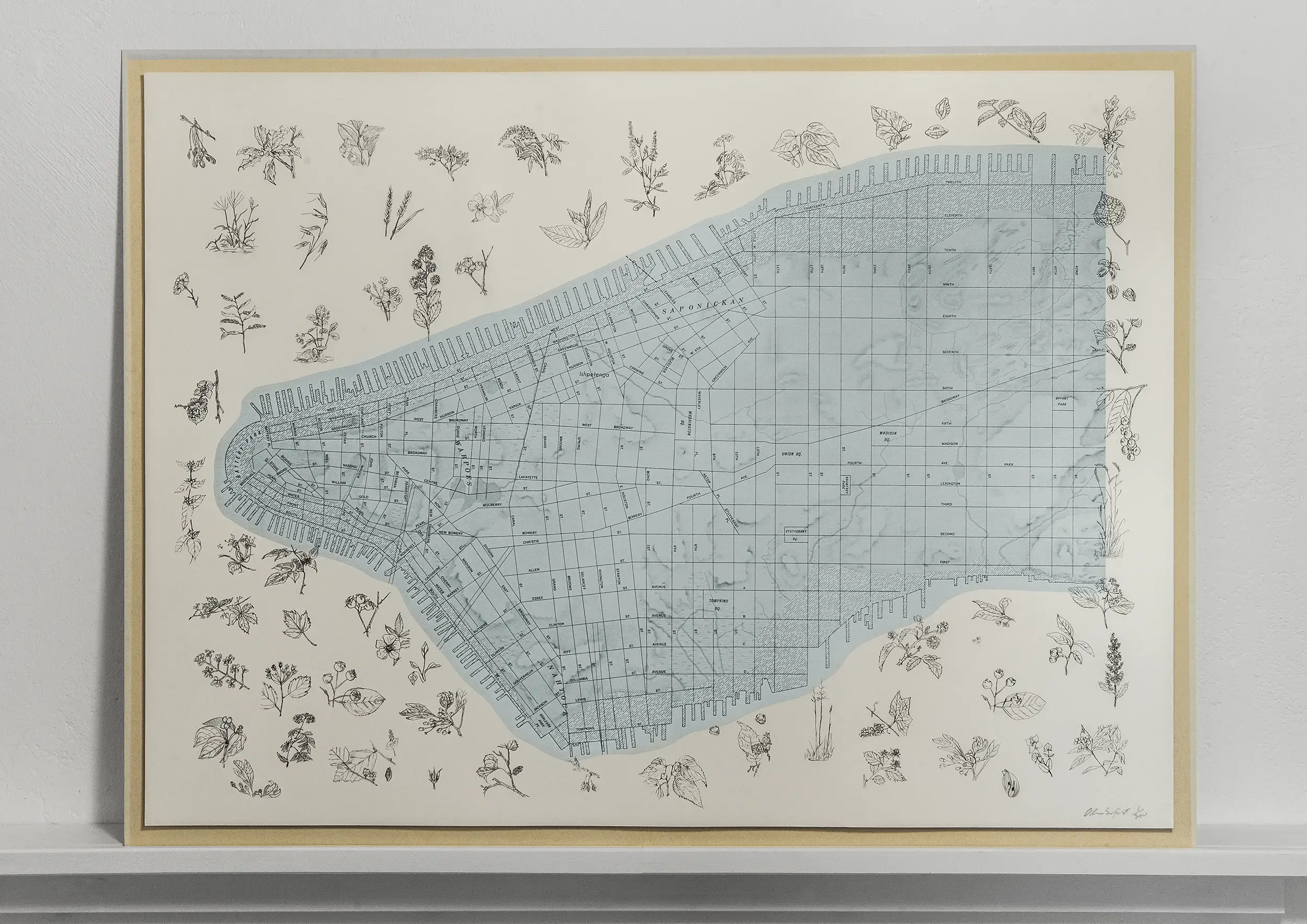
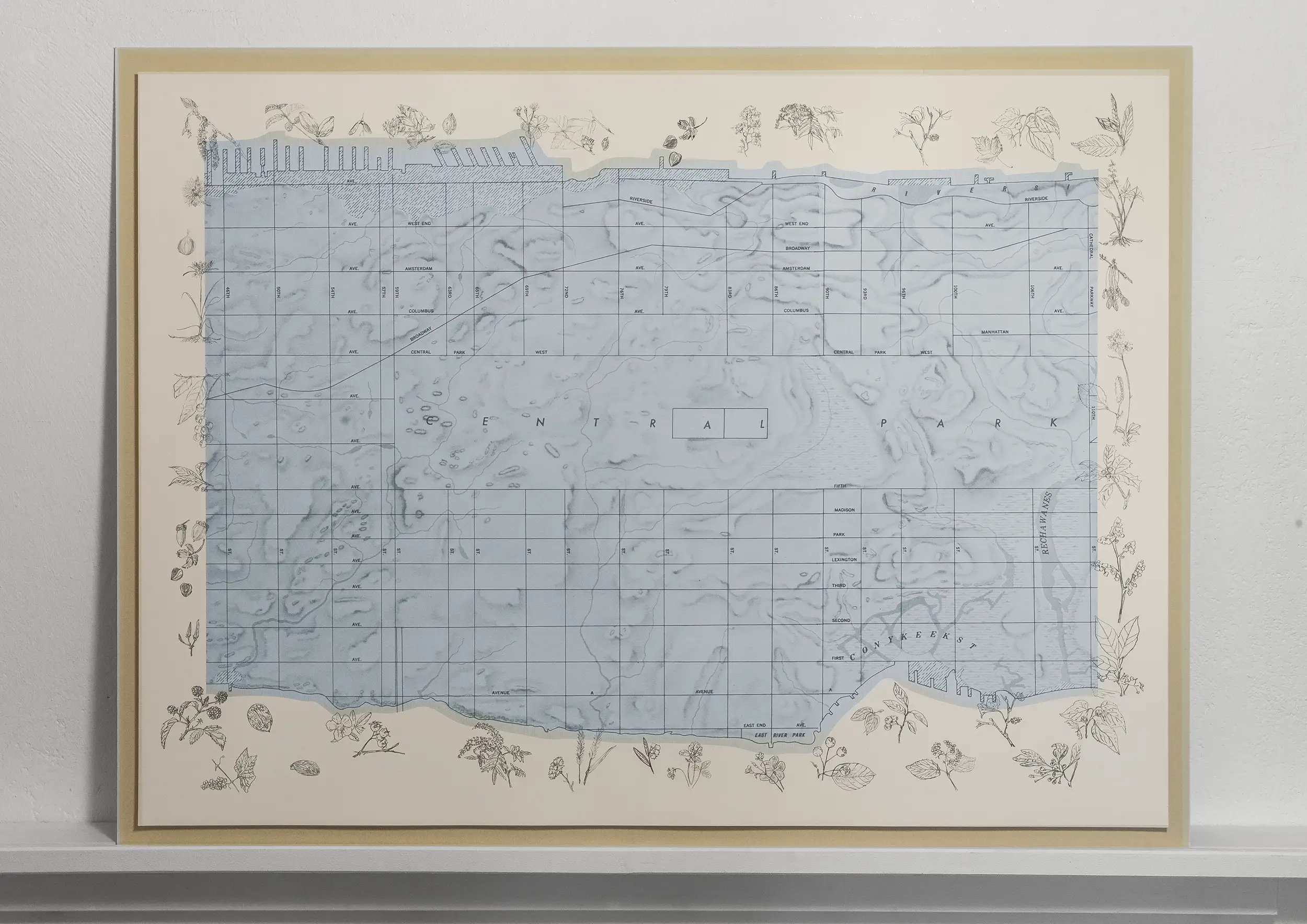
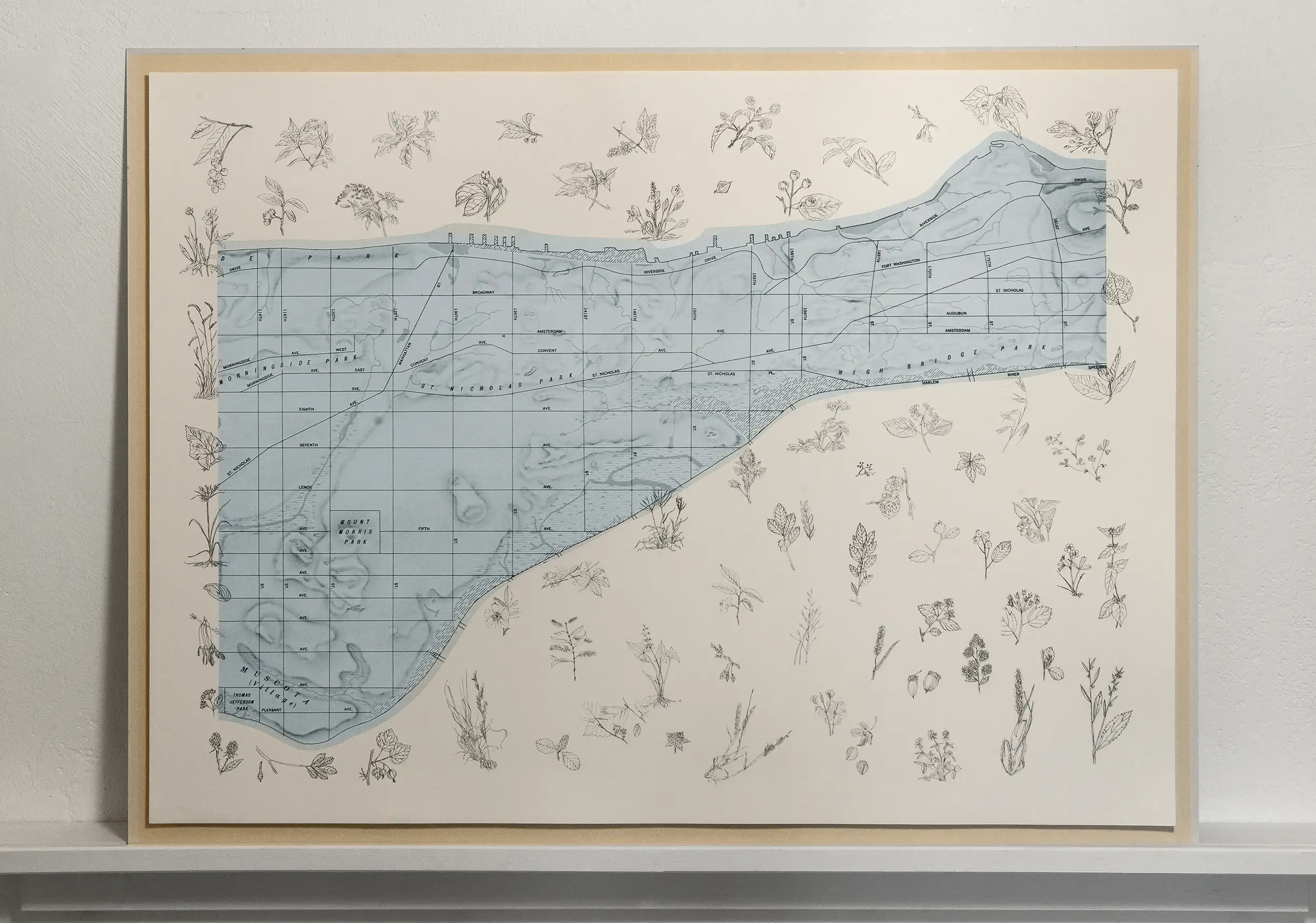
Manhattan Trytich is a set of lithographic prints by Alan Sonfist closely connected to Time Landscape. The set of three prints offers a panoramic bird’s-eye view of Manhattan. Along the waterfronts and on the white areas of the superb quality acid-free printing paper, Sonfist places intricate illustrations of indigenous plants, visually reconnecting the well-known Manhattan geography with its original flora. Rather than a conventional street map, the work focuses on Manhattan’s parks, with only a limited number of street names indicated – an invitation to the viewer to consider the interaction between urban life and the natural world that once existed in this location. Before becoming a city, Manhattan was a forested island inhabited by the Lenape people and called Mannahatta. The Lenape are an Indigenous people whose ancestral homeland includes present-day New York, New Jersey, and parts of Pennsylvania and Delaware. They are a Native American or American Indian nation of the United States.
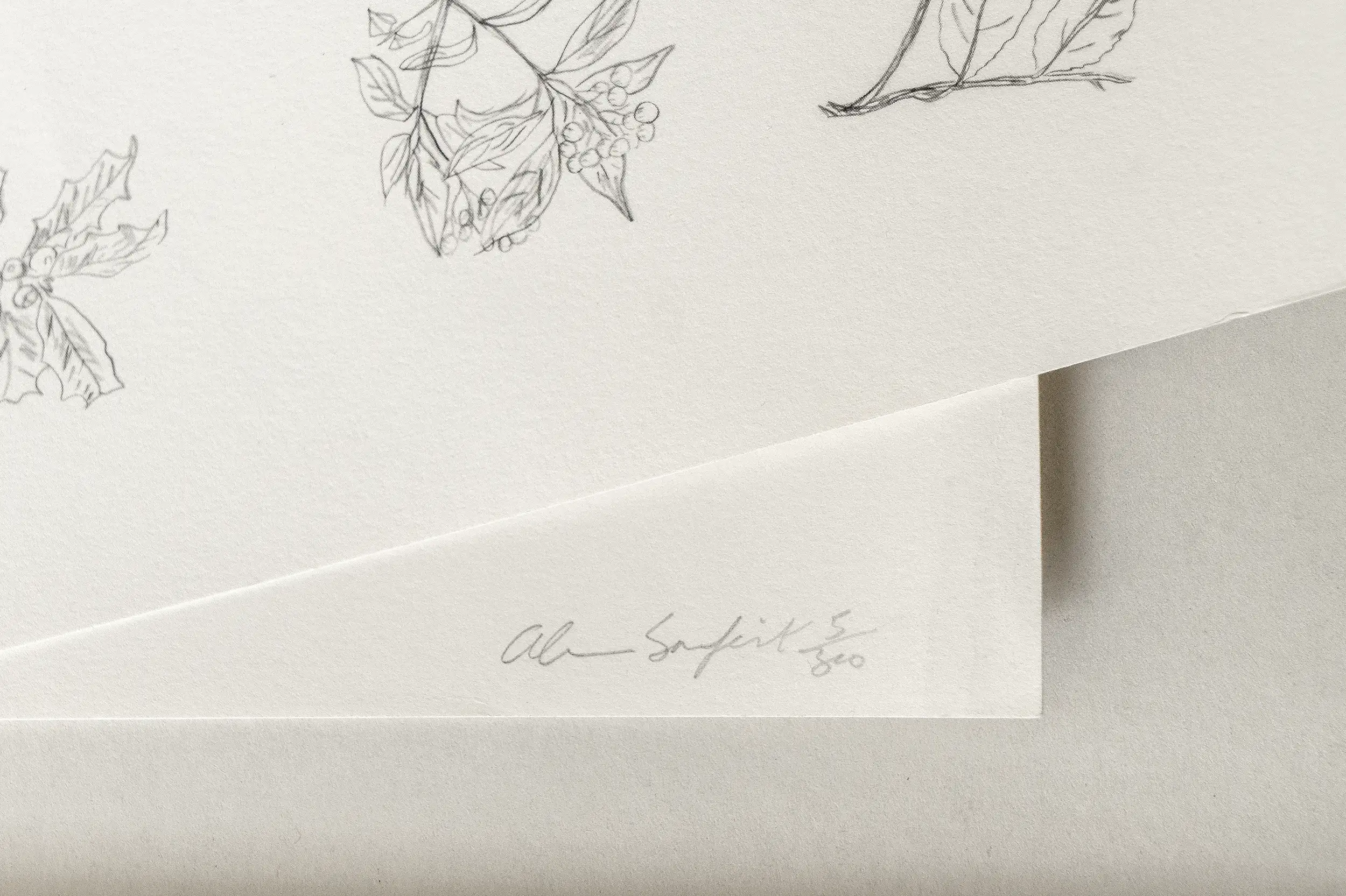
We have the set of three lithographic prints of the “Manhattan Trytich” from the year 1980 in two variations. The image and sheet size is 22 x 30 inches (55.88 x 76.2 cm) for both. Each is signed “Alan Sonfist” and numbered in pencil on the left print, the middle and right prints are unsigned. We have the editions 1/300 framed and 5/300 unframed in our collection.
More about Alan Sonfist:
In 2025, the influence and vision of Sonfist are highlighted in “Seeds of Time,” his solo exhibition in Italy, held at Parco Arte Vivente (PAV) in Turin. The exhibition explores the artist’s early career and his pioneering approach to environmental art, featuring a newly commissioned installation, “Growth Between the Cracks.” This work, created with the active participation of the Turin community, investigates the resilience of nature within the city’s overlooked spaces. Sonfist’s artistic praxis, both in New York and Turin, challenges audiences to broaden their understanding of public monuments and community to encompass not only human existence, but also non-human life. This emphasises the enduring significance of ecological memory and stewardship.
Alan Sonfist Studio page on “Time Landscape”
“Seeds of Time” information booklet (2025 pdf) of Parco Arte Vivente (PAV) Torino
Further reading on Time Landscape:
“Sonfist is known for a variety of objects, including rubbings made from trees and didactic presentations in which the gene composition of a leaf is shown. Sonfist’s chef d’oeuvre is Time Landscape (1965-1978), a parcel of earth on West Broadway (1978) in New York City on which are planted the trees and shrubbery that would have been found in the pre-Colonial forests of the city. Like the work of the preceding group, Time Landscape presents nature in an unadulterated, unmodified state as the fundamental content of the work. The fact that this portion of nature is contained and bound up by a fence and located a few hundred feet from the center of SoHo reflects Smithson’s influential “nonsites,” in which raw nature is contained for presentation in an art context. […] Time Landscape is completely site-specific in all of its aspects, although it is in reality a memory of the site. One might ask where the “art” is in Time Landscape, that is, where is the formal composition in this ostensibly formless environment. In contrast, Smithson (Spiral Jetty, 1970) creates a very powerful, formal geometrical composition. His spiral is clearly an addition, a human gesture, made to the site. He maintains the importance of art, or perhaps his own self-importance, whereas Sonfist immerses art and himself in the site. This is not to say that Sonfist’s work, unlike Smithson’s, is passive and unprovocative. His work creates a dialogue between abandoned and current values, between concerns for the land and the priorities of an urban landscape.” (Mark Rosenthal, Some Attitudes of Earth Art: From Competition to Adoration, in: Alan Sonfist, Art in the Land, pages 68 and 70, New York 1983)
“Alan Sonfist’s New York City-wide Time Landscape (1965-1978), most visible to the art world in its segment at the corner of La Guardia Place and Houston Street (1978), is an example of the artwork as a major urban-design plan. This ambitious and carefully researched undertaking consists of a network of sites throughout New York City’s five boroughs, where sections of land have been restored to the way they might have appeared in the seventeenth century, before the advent of urbanization. Sonfist spent over ten years developing the project and finally pushing it to fruition. To complete the La Guardia Place site, he had to weave his way through community groups, local politicians, real estate interests, several arms of city government, art patrons, and their lawyers. It was only after shaping alliances with influential neighborhood politicians and agreeing to important compromises with community groups that Sonfist finally brought Time Landscape to completion. Even in the final stages, as the “sculpture” was being constructed, problems that developed with a tree supplier were almost enough to quash the piece. […] the piece has so far cost $74,700 to build and maintain. Sonfist managed all of this without a patron or a sponsoring organization.” (Jeffrey Deitch, The New Economics of Environmental Art, in: Alan Sonfist, Art in the Land, pages 87 and 89, New York 1983)